The Four Chromatic Windows of the High North
In temperate latitudes, spring green-up and autumn senescence unfold slowly over months. North of the Arctic Circle—in regions such as the Toolik Lake research area on Alaska’s North Slope or Sweden’s Abisko valley—plants operate under 24-hour daylight in June and rapidly diminishing solar angles by late August.
When snow melts in early June, overwintered leaves of evergreen dwarf shrubs such as mountain avens (Dryas octopetala) and crowberry (Empetrum nigrum) emerge dark bronze-brown before flushing olive green. By mid-July, wet sedge meadows turn bright chartreuse while well-drained gravel ridges burst with magenta purple saxifrage (Saxifraga oppositifolia) and sulphur-yellow Arctic poppy (Papaver radicatum).
The most intense palette arrives in late August. As soil temperatures drop near 0°C, dwarf birch (Betula nana), bog blueberry (Vaccinium uliginosum), and alpine bearberry (Arctostaphylos alpina) break down green chlorophyll to resorb precious nitrogen into their roots. Simultaneously, they manufacture high concentrations of red and purple anthocyanins. These pigments act as a sunscreen, preventing light-induced cellular damage while leaves finish transporting sugars underground before winter freeze-up.
How Ice-Wedge Polygons Organise Tundra Colour
Looking down at low-lying coastal tundra near Tuktoyaktuk in the Northwest Territories or across the Lena River Delta, the ground resembles a stained-glass mosaic of geometric polygons measuring 10 to 30 metres across. This patterned ground is built by winter thermal contraction cracking of permafrost, followed by spring meltwater filling the cracks and freezing into vertical ice wedges.
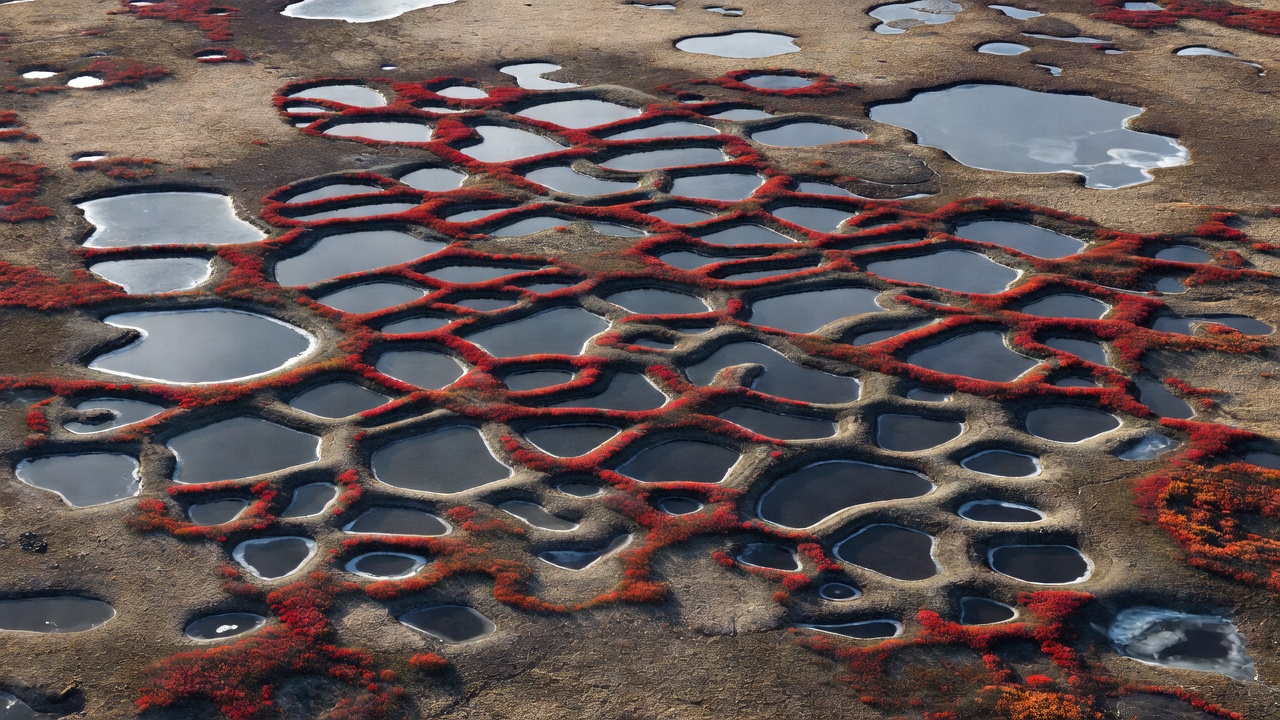
Centimetres of Elevation Change Everything
Because underlying permafrost prevents water from draining downward, an elevation difference of just 25 centimetres between a polygon’s raised rim and its depressed centre creates two completely different plant communities—and two distinct colour zones right beside each other.
Illustrative Seasonal Swatches
Derived colour swatches are illustrative field references, not scientific measurements.
Lichens: The Year-Round Mineral Palette
Even when vascular plants lose their leaves, dry boulder fields and wind-scoured ridges retain vivid colours courtesy of lichens—symbiotic partnerships between fungi and green algae or cyanobacteria. Lichens produce specialized secondary metabolites (such as usnic acid and parietin) in their upper cortex to filter harsh UV radiation and deter grazing.
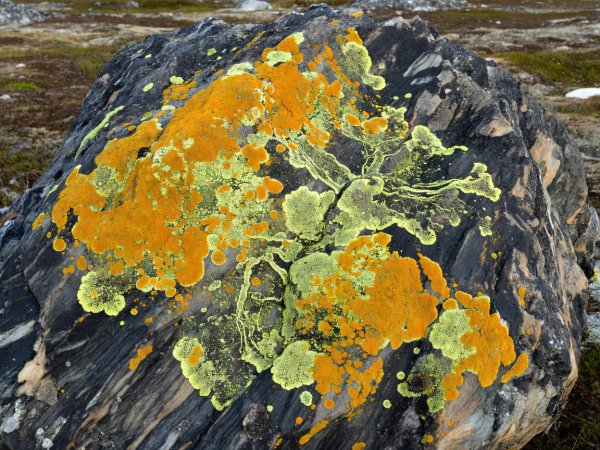
Nutrient Indicators on Rock
Bright fiery orange patches of elegant sunburst lichen (Xanthoria elegans) on dark coastal cliffs almost always mark perching rocks below seabird colonies or Arctic fox dens, where nitrogen-rich guano fertilizes the rock surface.
Map Lichen & Lichenometry
Chartreuse-green disks of map lichen (Rhizocarpon geographicum) bordered by black spore-producing margins grow outward at fractions of a millimetre per year, allowing geomorphologists to estimate how long boulders have been exposed since glacial retreat.
Evaluating Tundra Greening and Browning
Shrub Patches & Dieback Zones
Hikers across northern Fennoscandia and western Alaska note dense alder and willow thickets in sheltered valleys alongside patches of brown, frost-damaged heather on exposed ridges.
Active Layer Depth & Winter Rain
Warmer summers deepen the thawed active soil layer, favouring deep-rooted shrubs, whereas winter rain-on-snow events encase low heath plants in ice, causing tissue browning.
ITEX Plot Measurements
The International Tundra Experiment (ITEX) network of standardized vegetation plots across 11 Arctic countries documents measurable increases in canopy height and deciduous shrub abundance since the early 1990s.