From Fresh Snow to Metamorphic Glacial Ice
Newly fallen snow on high plateaus such as the Penny Ice Cap on Baffin Island or Austfonna in Nordaustlandet consists of delicate six-sided crystalline plates with a bulk density of roughly 50 to 100 kilograms per cubic metre. Because millions of air-ice interfaces exist within every cubic centimetre, incoming sunlight is reflected back out before travelling more than a few millimetres. The human eye registers this complete broadband reflection as bright white.
As seasonal snow layers survive summer melt and become buried beneath subsequent winters, delicate crystal points sublimate and re-condense around thicker grain cores, forming granular firn (density 400 to 800 kg/m³). At depths typically between 50 and 80 metres, overburden pressure seals off interconnected air passages altogether. True glacial ice reaches densities of 830 to 917 kg/m³. With air bubbles compressed or dissolved into the crystal lattice, photons travel deep into the ice block. Because the oxygen-hydrogen bonds in water molecules absorb longer red wavelengths slightly more efficiently than shorter wavelengths, light emerging from deep fractures or subglacial cave ceilings has been stripped of its warm spectrum.
| Material Stage | Typical Density (kg/m³) | Air Volume (%) | Visible Field Appearance |
|---|---|---|---|
| Fresh Dry Snow | 50 – 120 | 85% – 95% | Brilliant matte white; high surface glare under direct sun. |
| Multi-Year Firn | 450 – 800 | 15% – 50% | Warm cream or pale buff; coarse granular sugar texture. |
| Bubbly Glacier Ice | 830 – 880 | 5% – 12% | Cloudy alabaster to pale grey-green along fractured seracs. |
| Basal Metamorphic Ice | 900 – 917+ | < 2% (plus sediment) | Translucent deep slate, obsidian-like dark bands, and bronze silt layers. |
Tephra Horizons, Ogives, and Basal Debris
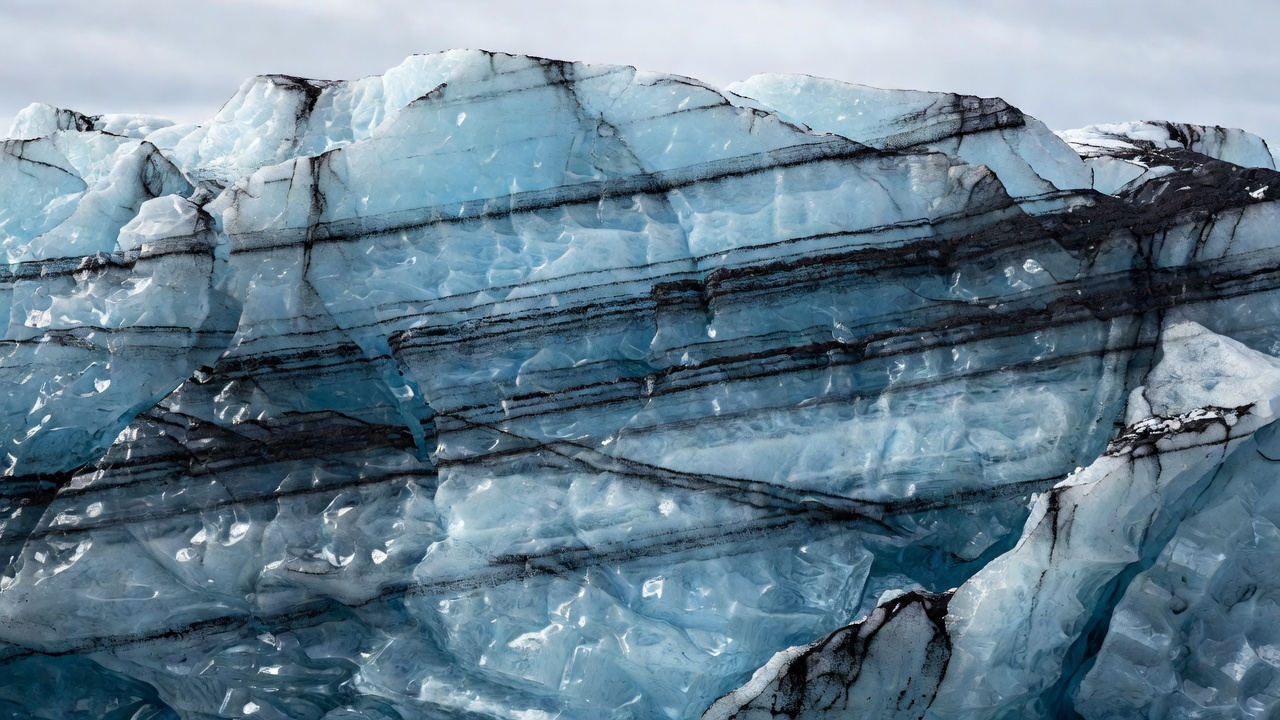
Walking toward the snout of Breiðamerkurjökull or Skeiðarárjökull in southeastern Iceland reveals dramatic dark ribbons looping across the ice surface. These patterns are a visual logbook of geological events and ice dynamics.
Volcanic Tephra Archives
When subglacial volcanoes such as Grímsvötn or Katla erupt, dark basaltic ash settles across the snow accumulation zone. Buried and carried down-valley over centuries, these ash beds re-emerge in the ablation zone as sharp charcoal-black lines that glaciologists can date precisely to historic eruptions.
Illustrative Glacial Swatches
Derived colour swatches are illustrative field references, not scientific measurements.
Where two tributary valley glaciers converge—such as along the Kongsvegen and Kronebreen system in Spitsbergen—their lateral moraines merge in the middle of the combined ice stream to form a medial moraine. Depending on the surrounding valley walls, these rock-strewn stripes paint rusty sandstone ochre, dark shale grey, or pale dolomitic buff lines down the length of the glacier.
Inside Winter Meltwater Caves
During the height of summer melt, surface water pours down vertical shafts called moulins, routing through pressurized tunnels at the base of the glacier. In winter, when surface melt ceases and water drains away, these subglacial and englacial conduits empty out, leaving vaulted caves accessible to field researchers.
Scalloped Ablation Ripples
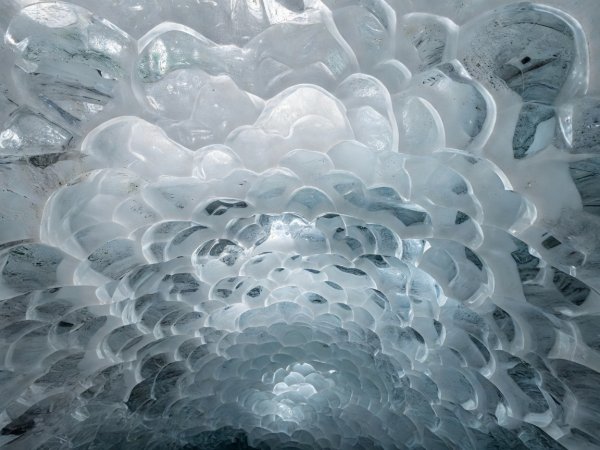
Cave walls rarely look smooth; they are carved into interlocking concave pockets caused by turbulent warm air currents and summer meltwater eddies. In caves beneath Longyearbreen in Svalbard, frozen basal gravels and coal fragments remain suspended directly overhead in the ice ceiling.
Cryoconite Holes on the Surface
On the sunlit upper surface of the glacier, windblown mineral dust combines with filamentous cyanobacteria to form dark granules called cryoconite. Because these dark specks absorb solar heat, they melt vertical cylindrical wells into the ice, forming miniature self-contained aquatic ecosystems.
Separating Observation, Process, and Evidence
Darkening Terminus Zones
In late July and August, the lower ablation zones of western Greenland glaciers appear visibly dusty, pitted with dark water-filled cryoconite holes and coated in brownish-purple surface sheen.
Biological & Mineral Albedo Feedback
Outcropping ancient dust layers combine with blooms of glacier ice algae (Ancylonema nordenskiöldii), whose dark purpurin-like pigments absorb solar energy and accelerate local surface melting.
World Glacier Monitoring Service
Continuous mass-balance stake networks and gravimetric satellite measurements (GRACE/GRACE-FO) confirm sustained negative mass balance across Arctic reference glaciers over the past four decades.